More on “the Value of Having Values”: beyond openness, smartness, and efficiency
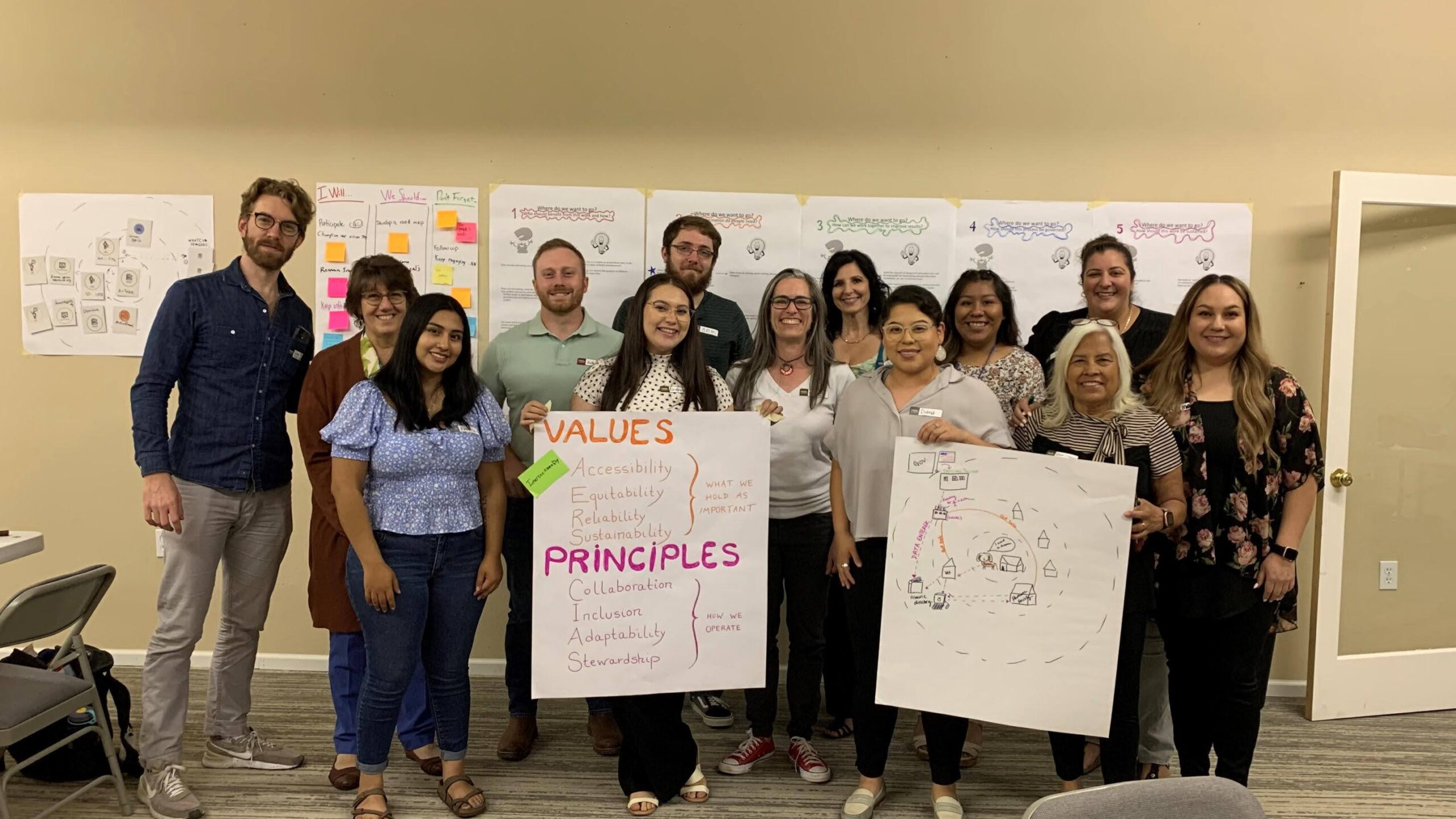
Late last year I posted a pre-publication paper which is now post-publication! From Cambridge University Press, The Environmental Knowledge Commons features my article “The Value of Having Values,” right up front: Part 1, Chapter 1.
I was of two minds when I wrote this paper – a practitioner thinking about theory, while addressing theoreticians about the realities of practice. Which is to say I strived for praxis. As I summarized in my first post, my message for academics who study the governance of knowledge commons is that value statements are “constitutional boundary objects” – artifacts that reflect the normative terms for all participants in a collective project – and as such can be applied as critical lenses for institutional analysis. And my message for practitioners is that value statements are tools for governance – and as such ought to be both designed through and used for participatory deliberation, strategy development, and institutional design.
I still suspect this may be a “no duh” kind of point. Indeed, the point is already implicitly made in the Governing Knowledge Commons (GKC) workshop, which has helpfully adapted Elinor Ostrom’s framework of “Institutional Analysis and Design” to address the distinct challenges and affordances of information as a resource. (Compared to natural resources, information is nonrivalrous and inexhaustible, made more valuable through use – but still subject to various collective action problems. The GKC workshop explores these variations and concordances.) In the GKC research framework, a list of diagnostic questions includes: “What values are reflected in goals and objectives (of the commons and its members)?” and “What normative values are relevant for this community?” These questions assume that a community’s values can be inferred through observation. Which, fair enough. As a practitioner trying to apply Ostrom’s theoretical framework to the social process of designing systems for sharing information, I think it can be helpful to ask explicitly: what values are declared in association with a given commons, and how are those normative claims used by members of the commons?
Of course there may be significant and illuminating differences between whatever statements are claimed to be values by a community, and the values that one might infer from behaviors in and of a community. Despite and because of the reality that values statements are not enforceable as rules per se, I think these artifacts deserve careful attention. As signifiers, they can help groups describe the tensions that bedevil collective action, consider the nature of the coping options available to them, and then muddle through efforts to align their actions with their values among tradeoffs and uncertainty.
But as I said: no duh? So I want to further unpack some implications.
“Openness” and “Smartness”: core values, or masks?
Throughout the paper I consider various examples of value statements, including “open” and “smart” – which tend to be put forth as a kind of floating short-code for a whole host of associated but often just implied values. We might be past the peak of each word’s popularity, but I still see plenty of examples of each going around – often without any further value statements to clarify what “openness” or “smartness” are good for. Which is a risky proposition.
As someone who founded and still leads a collective action initiative under an “Open” handlei, and still subscribes to many “open” projects, I admit to a certain wariness with the concept of open. It’s (usually) not a bad value, but we’ve learned many times over that there’s a troubled relationship between openness and other values like justice and dignity. In principle, anyone can benefit from something that’s open. But in practice – in our actually-existing inequitable world, all other things being equal – actors who have more power are more likely to gain more benefit from something that’s open than those who have less.ii This is not to say that openness is inherently bad, of course, but rather that I’ve come to understand it as a secondary attribute that supports other primary values and objectives.
And “smartness.” Oh gosh. Honestly, no thank you. “Smart” sounds like someone nobody would argue with, but it usually just means “datafied” – and, with it, surveilled and controlled. Of course, others have taken on this unfortunate branding strategy more effectively than I can here.
Lurking in the shadows around both of these value statements (but not addressed explicitly in my paper–it was long enough already!) is the specter of the ur-value of neoliberalism: EFFICIENCY. Doing more with less; or, in some contexts, you might say, doing the least.
I can’t think of many initiatives that actually claim “efficiency” as one of their core values up front, but in fields like “civic technology,” and throughout innovationista entrepreneurship culture generally, there is a very widespread and mistaken assumption that efficiency is an inherently positive value. If not the goal in and of itself, then it’s at least the main criteria by which “progress” is commonly gauged. Perhaps you, too, have had experiences in which functional values (fairness, inclusivity, etc) are sacrificed on the altar of efficiency – sometimes while it’s pretended that those other values have been upheld as a function of efficiency gains – resulting in situations that are… actually less effective.
(See Luke Herrine here for further explication of the different value systems implied by efficiency – and how the slippery perniciousness of this value has done so much harm to society. I also appreciate Charley Johnson’s point here on the trap of efficiency and scale in the context of “tech for good.”)
Of course, sometimes some things really should be made more efficient! But when it comes to knowledge resources, many values that motivate people – like justice, democratic accountability, etc – are inherently inefficient. Such inefficiencies may be okay, or as Eric Gordon has written, maybe even meaningful and good. Most social endeavors should ensure that efficiency remains no more than a tactical consideration – a lower-order concern, tertiary to primary goals – which may mean sometimes it’s efficiency that should be sacrificed. In this struggle, values statements are some of our best (only) weapons.
Given a plot of forested land, the most efficient – “smartest” – thing that homo economicus knows how to do is to cut it all down. Open that land up for development. Given a set of values – beauty, resilience, the dignity of living things – you might arrive at some other ideas.
So these questions – how should we arrange ourselves and our organizations in accordance with our values? – ought to precede or even supersede the typical focus on interface design or data system engineering or business model innovation or policy mechanism, etc. Brett Frischmann (a GKC workshop co-founder) writes about “governance seams” – contexts within sociotechnological systems that are designed deliberately to add friction in situations where decisions ought to be carefully made – and he offers some examples in the context of user interfaces: instances in which the user’s innate instinct toward smooth frictionlessness ought to be frustrated. (For instance, Frischmann posits that extra steps might be added to a process by which a user is asked for consent – steps that are probably annoying to the user, yet increase the likelihood that the user really thinks about what they’re agreeing to, and what their options are, rather than just clicking “Accept” as fast as possible.)
To defend knowledge sharing initiatives against the perils of openness, and the zombifying spectre of efficiency, we need the same kind of approach to governance seams in our organizational designs: frictive spaces in the lifeworld of an institution where impacted actors (probably not just an executive or even a committee) are prompted to pause or even stop and ask, what should we do? When we pass through such seams together, we might see and hear things that are uncomfortable and cause for doubt. That’s where our value statements can do their most important work.
Keeping Light in the darkness
I would have been really excited to post this essay in the early days of a new Democratic administration… in our actual timeline I’ve really struggled to pull it together. Not just in the U.S. but globally, the open knowledge movement, to the extent that it still exists, seems to be adrift in a darkening fog. Why write about values in the service of building things when we’re currently witnessing the most cataclysmic destruction of value in generations?
Well if we’re lucky, we may have a chance to rebuild. And given that the Open Knowledge movement wasn’t exactly a wild success before the wave of fascism (nor were the Civic Tech movement or the Smart City whatever or what have you, if we’re being honest), perhaps this kind of rethinking can be helpful in some future Reconstruction.
In the meantime, however, given the rise of eugenic fascism here and abroad, those of us doing this work may also need to rethink in entirely different near-term directions. The hardest and most important questions to ask might not be about how to keep going — but rather if the strategies that we conceived of under a putative liberal democracy are still actually in line with our values now that we live under eugenic authoritarianism.
On one hand, in dark times it’s more important than ever to envision the kind of world we want. But on the other hand, actually applying our values to the realities of our current world may entail a very different set of near-term objectives, less about building that world and more about gumming up the works of this one. In the days after the last election, Katya Abazajian invited us to embrace refusal as a strategy for transformation: we can design capacities to refuse the further encroachment of a future that has no place for our values.
I know that this word refusal is out of step with the general Abundance vibe of the can-do elite scene. But given most human values, more is not necessarily always better. Sometimes a high volume of low quality stuff is bad! Growth is what cancer does! Even when we want things to change, we have to recognize that doing something is not necessarily better than doing nothing. By reflecting on our values, we can discern the difference — then draw some lines, and do whatever we can to keep some things on the other side of those lines.
This is one of the distinctions that, not to be overly dramatic, could make the difference between civilization and savagery in the years ahead. As the rising forces of fascism and “AI” further converge into each other, and one institution after another faces various pressures to either submit or be dismantled, we must reorient ourselves by using our values to envision better possible futures than that which is afforded us by mere efficiency, while also summoning the courage to stop that which is anathema to what matters most. We may find paths that lead us to very different places.