In memoriam: Matt Siemer & AJ Barks
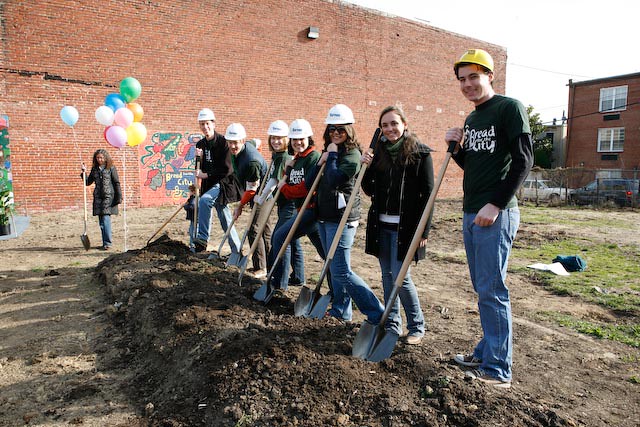
Matt Siemer and AJ Barks lost their lives in a car accident last December. They were friends and people I deeply admired, and when I saw the news I immediately sent despondent messages to a bunch of people I haven’t seen in a long time and spiraled out in my journal. I feel like I owe it to them to gather some shareable thoughts here (since this extremely sporadic blog has been about memorializing lost leaders and friends as much as it has been about anything else).
I met Matt during my interview for a staff position at Bread for the City. This job is still the actual-employment job I’ve liked best (not a particularly high bar to be sure), and in a way Matt was my main guide through my onboarding into that world. I was the “communications guy” and he was the volunteer coordinator, we both sat in the “Devo Office” (ie development). Our roles didn’t have all that much to do with each other except that the stories of the organization were our currency. About how the Food Pantry worked with both volume and care; how the medical clinic helped mend thousands of whole broken people; how the legal clinic helped a family one day and won policy concessions the next; how the social workers tried to figure out how do almost anything else that could be done. In that first formative year, he helped me see how all of this was happening in the organization, and also to see so many things about the world we operated in that made it all necessary.
I shared much affinity with Matt, one of those rare examples of non-toxic masculinity. A real weirdo but in the most good-humored way. He wore mismatched socks every day and had been for years, apparently on a dare. (It was a habit I tried myself for a few months before concluding that I didn’t have the charm to really get away with it.) He was constantly reflecting upon the quality of this or that arrangement or idea, the gap between intentions and outcomes, describing it in terms that would veer from somber to hilarious and back in the same breadth.
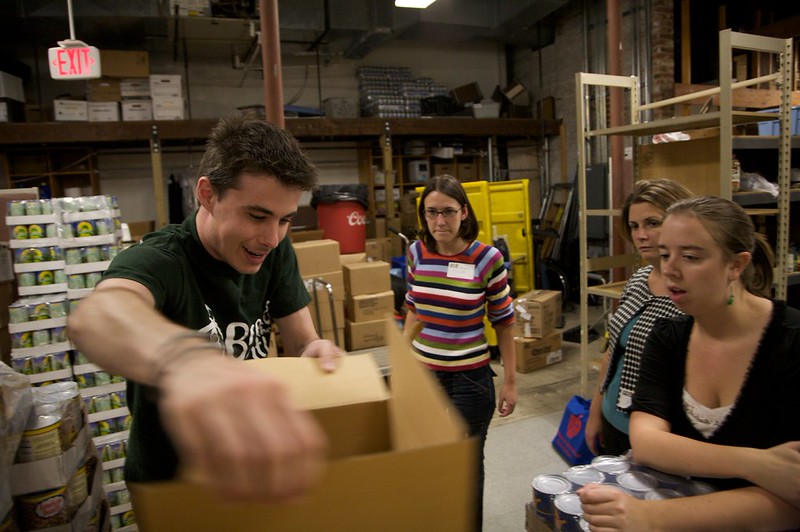
He was agreeably ironic about the fact that his actual job was at least in part technically bullshit: the whole volunteer program didn’t actually amount to much in the way of organizational capacity. We didn’t actually need drop-in volunteers to sustain our professional operations.i It was just assumed otherwise by many people, especially people in the corporate social responsibility offices of companies in the city, and as a way to open their door to ask for actual money, we spent our staff time to accommodate them rather than disabuse them of the notion that their time was needed. Matt would give them a tour, then place them in the food hangar where they would unpack and flatten food cartons, then take a photo and thank them for their service. These volunteers were often trained professionals on a work-mandated service day, their time was probably worth enough that they could have easily saved the hour, made a donation of $100, and everyone would have come out ahead. Matt believed that building relationships with these people and their organizations could be valuable even if the time they volunteered actually wasn’t. He wouldn’t pretend otherwise if you asked. But he also wouldn’t throw it in your face.
In that, he and I were built different.
As I became more comfortable in the organization, and more appreciative of the breadth of knowledge and depth of relationships that weaved through the place, I became more excited about what we could try to accomplish there. After a year on the job, my ambitions started outgrowing the job itself. The organization was expanding into a bright and capacious new facilityii and I was organizing budget advocacy campaigns, community wireless networks, etc. I considered Bread for the City a platform on which we could conduct transformative social alchemy: not just a service mechanism, but a base for building power. Cross-class, interracial, community power.
I assumed Matt would see this potential too and join in this mission. But Matt was never so presumptuous as to call a meeting, let alone challenge people to consider what we might do differently together. The only time we ever had cross words with each other was actually the week I launched the Save Our Safety Net campaign. Matt was concerned, understandably, that it would blow up in the organization’s face, and protecting the organization struck him as more important than the potential benefit of any organizing adventure. At the time I thought he was just too nice, and too risk averse. But now I’d say that though he was always interested in exploring boundaries, he was never one to push them, and rather had a Taoist disinterest in grasping for leverage: nothing that would impose himself upon another person for any purpose other than assistance or delight.
It felt sudden to me when Matt announced that he was leaving to go to grad school – to study hermeneutics, of all things. I was a little surly about it, maybe also patronizing, and pretended to not understand what “hermeneutics” meant.iii But if you read this correspondence from Matt that I published on this blog with his permission (one decade ago this week), you can get a sense of it.
We drifted apart after that, but we didn’t fall entirely out of touch. From afar, his behavior on Facebook turned outright impish, selecting the female gender and the name Vincent St Simon (I never was sure whether it was a reference to the apostle or the socialist), and RSVPing “Yes” to every event that I organized long after he was no longer in DC, events I organized in other cities. Just mild trolling, and if it was ever commented upon he would then break into lengthy existential reverie that reverberated on the screen with the sound of his Bavarian Herzog impression. Typical of Facebook, I can’t find much of the content from these exchanges anymore.
Over time, after grad school, he and AJ both followed similar courses: they each volunteered for a service organization (he, a mobile health clinic; she, a women’s health center) and in these places – small, scrappy – the volunteering appeared to really matter. From my limited understanding, they seemed to be the kinds of organizations that Bread for the City itself had originally emerged from back in the 70s: volunteer-driven, peer-managed, and intimately entangled with the communities they were designed to serve. In each org, Matt and AJ ascended over the years to become executive directors.
I managed at least a couple of visits to see them, both brief but joyful. In recent years I’ve done a bit of work in Chicago and I kept vaguely anticipating that there would soon be a moment ripe enough for me to reach out and elicit their input, maybe even try to get them engaged. The moment never came. I shouldn’t have waited.
For me, this loss cut into a part of my psyche that’s already been deeply bruised and aching. During that time in DC, I felt like I’d finally arrived personally and professionally at a place of purpose: I was working in my community, at a principled and beloved institution, under a hopeful transition to an exciting new federal Administration. The ’08 election unfolded across my first year on the job, and after the gloomy Bush years it felt like the most exciting place to be in the world. In between photo ops at the food pantry and client advocacy meetings, we talked about a lot of big ideas for the future: a guaranteed income, a civil Gideon, a network of cooperative grocery stores linked to self-organized urban agriculture projects, a reclaimed capacity for tactical and equitable urbanism. When the Citibikes were first installed, I tried to get out of them a commitment of a thousand free passes as transportation assistance for Bread for the City clients; it didn’t happen, but it didn’t seem totally out of the question. I remember walking around with Matt on Rhode Island Ave, spitballing ideas for a campaign to ban cars and reclaim it for bikes and pedestrians (like they have recently done on Georgia Ave like one day a month). When the Great Recession hit DC’s municipal budget, and the city moved to cut human services right when need was skyrocketing, we spent tense, anxious hours talking with our executive director about what it might look like to stop playing only defense – if they’re going to cut back funding just when more people are coming to us for help, we eventually wondered, well we should show everyone what the true cost of austerity really is. Go on an organizational strike, lead the service nonprofits in a mass walkout, open up camps on the Mall. Pick up where MLK Jr’s Poor People’s Campaign tragically left off. This was a year before Occupy Wall Street. Just a couple years later, Matt was back at school and my organizing efforts at Bread for the City had caused enough tsuris that I also had to leave the organization. Not five years after that, the moral arc of the universe zagged away from justice; now, a whole generation later, it’s hard for me to even believe in very idea of an arc that bends that way. For ten years, I’ve been telling myself that I’m doing the work of grieving for the loss of our generation’s future; losing Matt and AJ made me realize that I’m an still an absolute beginner in true grief.
But of course loss has its own logics, and they work in weird ways.
After the accident, though Matt had gone immediately, AJ was in intensive care. It sounded like maybe she had never regained consciousness. I gave money to the gofundme and held her in my thoughts, and kept checking for updates. A week or so later, she too passed. When I saw that news I felt another drop in my gut, but then, to be honest, it was swiftly followed with a kind of release. Sorrow for her family and friends – but for AJ, and for AJ & Matt together, I felt a kind of relief.
You see, that first year I lived in DC, I only had the Smiths’ Singles CD in my car; whenever I started the car, it would start from the top (“Hand in Glove”). And whenever I gave Matt a ride somewhere, he’d skip to the last song, and leave it on repeat, then keep singing it afterward in the office, maudlin as the moment could allow: “There is a Light that Never Goes Out.” Who knows how many times we sang it, giggling at Morrissey’s histrionics, marveling at the extravagant deliriousness of his emotional posture, the idea that you could share such a depth of feeling with another that even the greatest misfortune would be an occasion to cherish. “To die by your side, the pleasure and the privilege is mine.” At least in the end they had that.
Love and miss you both forever.
Comments (2)