New paper: the Value of Declaring Your Values
A few years ago, shortly after I’d published “Averting Tragedy of the Resource Directory Anti-Commons” in The Cambridge Handbook on Commons Research Innovations, Angie Raymond asked if I would contribute a chapter to a book about environmental knowledge commons.
Governance of environmental knowledge? Sounds like some of the most important work in the world, I told Angie, but it’s just not an area I have any direct experience in.
Angie insisted that I could come up with something relevant to contribute. And I’m glad she did 🙂
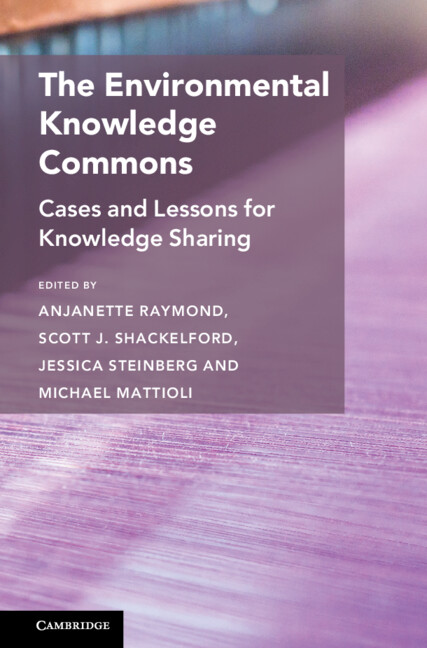
The resulting paper is now pending publication in The Environmental Knowledge Commons, coming soon from Cambridge University Press, edited by leadership of the Ostrom Workshop at Indiana University (where I am still, to my ongoing delight, welcomed as a visiting scholar). I presented a draft over a year ago at IU’s seventh quinquennial Workshop on the Ostrom Workshop; and now that it’s been edited, I’ve been graciously permitted to share a pre-pub version here.
Check the paper out embedded below, and linked here. I would welcome your feedback, so I’ve left comments on.
The paper is entitled “The Value of Having Values,” and in case it’s not already clear from the start, I’ll just add that I still wonder whether the point it makes is kinda like ‘no duh.’ Statements of values and principles are standard sections of organizational About pages, arguably banal if not quite ubiquitous. But sometimes it’s worthwhile to make explicit that which might otherwise be assumed but undiscussed. In this case, I think we should take care to say what we consider to be “good.”
If right now you’re thinking, “no duh,” I get it. But I wrote this at the risk of stating the obvious because drafting value statements has come to be a foundational part of my practice as a commoning facilitator (for instance – here, and here, and here, and here, and here), and I wanted to explain the theory behind it.
What are your values and principles – and are they written down? is almost always the first pair of questions I ask when connecting with a new party, whether it’s a one-time chat or a major consulting contract.i Sometimes groups already have value statements written down, but often they don’t; and even when they do, I sometimes hear that these statements are considered to be outdated or unclear. Sometimes people are resistant to the idea of taking the time to articulate and agree on such statements; people may have experience with conversations about such abstract subjects that were tense, boring, unproductive, etc. Whether or not they know their game theory (probably not), people often seem to consider discussion of values to be “cheap talk.” Setting aside the question of whether cheap talk actually does have value (I think it does!), I think value statements are very useful – or rather they can be useful, when they’re intentionally designed and actually used.
To get bit jargony for a moment: in the paper, I make the case that value statements should be considered constitutional “boundary objects” – which is to say, tools that groups can use to design a kind of moral and ethical space in which different kinds of people with different interests can form a shared identity, and with it, shared normative commitments. Value statements tell us (or rather help us tell ourselves) who we are, what we want to be like, and by correlation what we don’t want to be like. The process of articulating such value statements can be a critical phase in the formation of a group’s identity; and by subsequently referencing these statements in decision-making processes, a group can grow through challenges, and maintain itself through changes. This kind of shared language helps us transcend the tragic individualism that otherwise often dooms efforts to act collectively.
In the final section of the paper, I describe my approach to working with groups to draft and revise values statements. This often sounds to people like it will be frustrating or even futile – probably because they assume it to involve writing by committee. It doesn’t need to happen like that. With a method like the Advice Process, for instance, specific people can be empowered to draft statements in relatively rapid iterative cycles, eliciting and incorporating feedback from all concerned parties through each iteration. (The first time I felt truly useful as a non-coding contributor to open source was when I coached a reluctant appointee of a major open source initiative that was undergoing a transition out from under its Benevolent-Dictator-for-Life status. He was tasked with managing the process of drafting a new set of principles to replace their founding statements which were essentially a decades-old bulletin board post. He admitted he expected to fail in this task. In 30 minutes we sketched out a project plan, which seemed to totally change his outlook; one year later, a new statement of principles was formally approved by their board.ii)
If, in these processes, any significant issues come up that reveal significant disagreement among parties, you’ve probably identified a significant conflict of interests among parties. That’s okay, of course – but figuring out how to address these issues early can make all the difference in avoiding tragedy later on.
I’ll have more to say on this topic – and how this relates to quite a few other topics – but will leave it here for now with a final note: I’m eager to hear your feedback on this paper and the work! Find me and let’s talk 🙂
P.S. Here again is the link to the doc with the paper. That GoogleDocs embed feature probably doesn’t look great on your device rn, but in principle it’s a good feature so I’m leaving it in (for now).